EDUCAUSE 2026 · Denver · Sept 29-Oct 2 Xopolis is at Emerging Tech Experience table T4. Workshop: Designing AI-Scoreable Assessments: Hands-On Evidence-Gated Scoring. Book a booth meeting.

Xopolis Inc.

Systems that extend what people can judge.

We build software that captures expert reasoning and makes it inspectable — in classrooms, inside organizations, and in applied research. Three platforms, one commitment: the judgment stays with the people who have it, and every conclusion traces back to its evidence.

Tell us what your organization needs to see.

Three platforms, built on the same idea.

Three platforms. One commitment.

Higher education

HeuriSight

See how students reason, not just what they answer.

Course assistants, team studios, case studies with digital twins and spoken assessments — each producing evidence of how a student reasoned, all of it accumulating into a model the institution owns.

See how it works

Organizations

ProtoBots

An internal marketplace of AI apps your organization owns.

Secure, private and organization-owned: teams customise prebuilt templates — Note Taker, Voice Translation, Pitch Me, Role Play AI, Design Your POC and others — into apps and automated workflows built for how they actually work. A workspace dashboard shows everything the organization has deployed, each app scoped workspace-wide or restricted.

Learn about ProtoBots

Applied research

xResearch

Instrumented studies on how people and AI reason together.

We publish working papers and the essays that make them readable, on reasoning, assessment validity and expert judgment. Each paper documents its search, states what it cannot show, and includes the studies that cut against our own product. NSF SBIR Phase I supports the underlying method.

Read the working papers Talk to the research team

The same method underneath all three.

How it works

Mapping how work actually gets done.

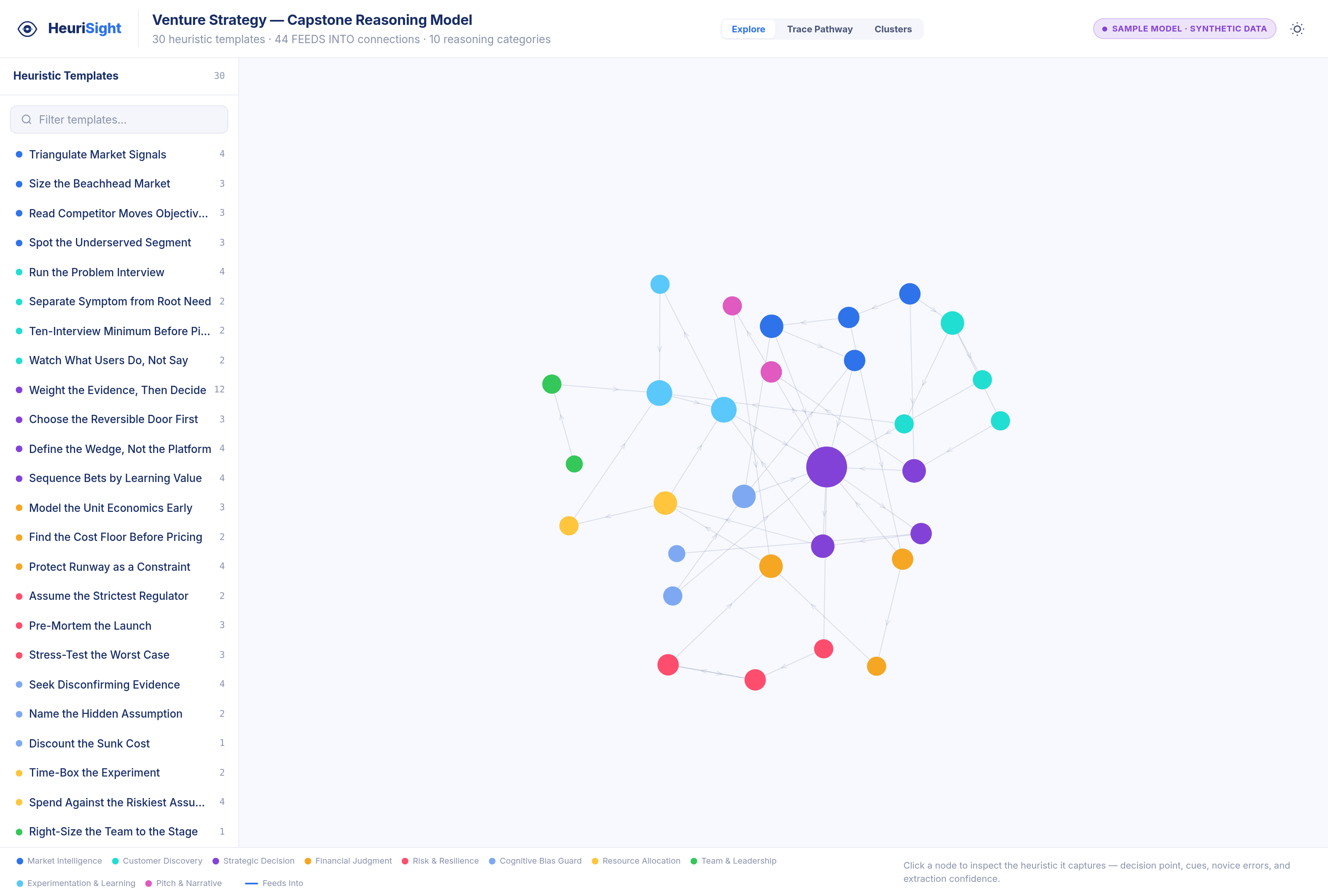
Retrieval-Augmented Generation tells a system what a document says. Heuristics-Augmented Generation (HAG) captures how an expert decides: the decision point, the cues that guided it, the mistake a novice makes there, and a confidence score on the extraction. Those patterns are stored as structured data owned by the organization that produced them — portable across models, and inspectable one by one.

A captured expert model: decision points linked to the cues that guide them and the novice errors to avoid, each carrying an extraction confidence score.

● Sample model · synthetic data

Which matters most where the work gets reviewed.

Built for organizations that get audited.

Every conclusion our systems produce opens to the evidence underneath it: the source, the turn, the confidence. That is a design choice, not a reporting feature. It is what lets a reviewer check a claim instead of trusting a summary.

ProtoBots maintains SOC 2 Type 2. HeuriSight is preparing for SOC 2 Type II with Vanta, with continuous control monitoring in place. Education records are handled under FERPA-aligned practices, self-attested.

Traceable by default

Any output opens to its source.

Human-adjudicated

A person approves or corrects. The record shows which.

Model-portable

The captured reasoning is your data. Swap the model underneath it.

The research track is where the method gets tested.

Government · research

Work that has to hold up under review.

Xopolis is an NSF SBIR Phase I awardee. The method behind HeuriSight is being evaluated in live university settings alongside our academic partners, and the reasoning behind it is published as a working-paper series, so a reviewer can check the work rather than take our word for it. We work with universities, agencies and workforce boards where the reasoning behind a decision has to be inspectable after the fact.

National Science FoundationBabson CollegeCSU Channel IslandsEDCAmerica's SBDCGeorge Mason University — Schar School, Center for Micro-Economic Policy Research

Institutional affiliations are listed for identification purposes and do not imply institutional endorsement.

What the library measures

Every claim in the working-paper series is anchored to a named construct, and every construct names the work that measures it, the primary sources behind it, and anything in the library that argues the other way. Pick one to see what the library holds on it, then open it there.

The constructs, the working papers that measure them and the sources that contest them are published in the library itself. Open the xResearch library to read them.

If any of this is a problem you have, say so.

Tell us what your organization is trying to see.

Whether it is a cohort, a team, or a study, the first conversation is the same: what decision are you trying to make visible, and who has to be able to check it?